| |
Listen to your wife. "Go play with Allan's trains!"
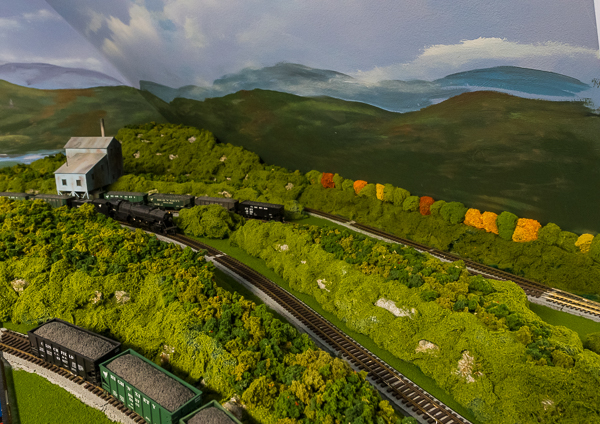
The coal mine at Three Way featuring the latest constructed mountain terrain that is on the east side of the Kudzu & Tenn. If you eyesight is good, you will notice I have not yet ballasted the track when this photo was taken. It is ballasted now. The track in the lower left is the interchange track with Keith Elrod's Tellico Southern.
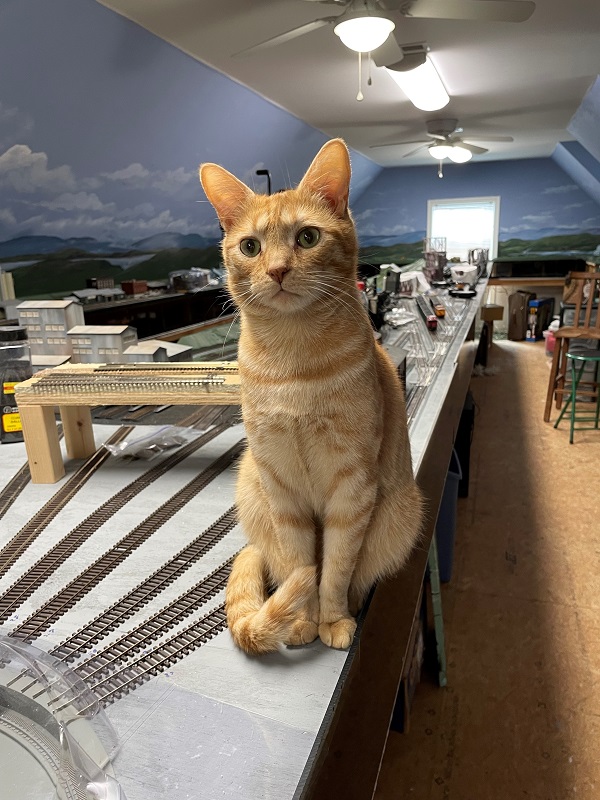
Track foreman, Jersey, likes to supervise construction on the Kudzu & Tenn. He is always there to lend a helping paw. I don't know why he is so fascinated with the train room. He really enjoys being in there with me. More of my cats that help out on the railroad are towards the bottom of this page.
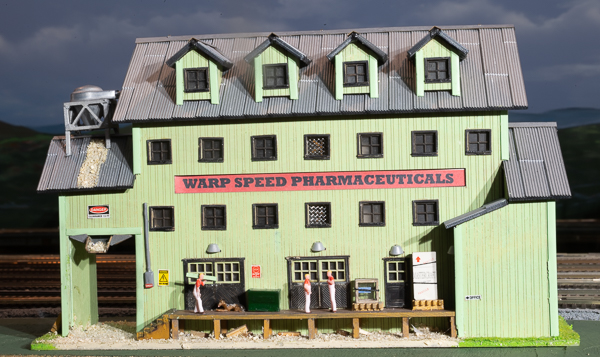
The layout that COVID-19 built.
The pandemic had given me a lot of time to work on my layout. I have repurposed one of my businesses as a vaccine factory.
Scroll to the bottom for the latest pictures of scenes on the Kudzu & Tenn!
Construction pictures
Mostly completed scenes pictures
Cat pictures
Click here to see the latest pictures 08/06/25
06/23/25 I added a picture of the coaling trestle. 05/04/25 I've started replacing construction photos with the more finished appearance the layout has today. Scroll down to see them. 12/3/24, I added Beau to the portraits of my cats that help out on the railroad. His picture is at the very bottom of this page. 12/8/24 I added a picture of Bucksnort & Boom.
Latest Status 07/21/26:
Since the last time I updated this webpage, I installed 12 block-triggered signals using LCC (Layout Command & Control). A lot of small wire wiring and getting up the learning curve made the first one a real project. By about the time I got the sixth one installed, I was able to wire a signal and configure the LCC node in about 2 hours. Whew! I'm glad to be done with this project" Now back to setting up car cards - another big project. :(
I have been very busy the past two months working on car cards for operations. I will spare you the gory details, but it is a lot of tedious work. Operations will definitely start this year; maybe during the late fall.
Now that Dennis Stoner has started helping me and has a few tools I don't, he is working on plugging two access holes I have in the benchwork. We are also putting in some more grade crossings. We have hung signs over the towns so that operators will know where the towns are.
Most of the people and vehicles are in place. In anticipation of operating, six signals and verbal short detectors have been installed. A verbal short detector is a circuit that detects a short, and mimicing a real life trackside defect detector, announces where a short is. Shorts most often occur when a train derails.
I have put down foam interlocking floor tiles with a rubber top surface. Very comfy for the feet.
I have completed the ground cover and ballasting. Lighted police and fire vehciles and building lighting have been installed. A few more to do.
Overview
I have
retired to Maryville, TN near Knoxville. The new layout is being
built in the 49' x 16'6" room over the garage - bigger than some clubs at about 740 square feet. Like my last
model railroad, I will be trying new thngs that you probably have
never seen done before.
The layout
is a folded loop capable of continuous running when viewed
by guests. For operating sessions, there is a wye in the middle
of the loop that will allow trains to be served by a yard that will
effectively will be two terminating yards.
So that
I don't have to lay on my back under the layout, all the wiring
is done from the front via hinge-down smoked acrylic facia.
Further, to avoid having to get under
they layout, there will only be switch machines for turnouts that are hard to reach. It gets better, there
will be no ground throws! There will be no control panels. Control
panels traditionally consume about half the time it takes to wire
a layout.
With all the facia panels being hinged-down,
the benchwork is octogon shaped for the turn around loops.
The smoked acrylic hinged-down facia allow viewing of status
lights without having to drill the facia for all of them as well
as label them.
All the town names used on this railroad are real towns in Tennessee. They are: Big Boy Jct, Bitter End, Boom, Boring, Bucksnort, Difficult, Falling Water, Frog Jump, Hornsbeak, Lick Skillet, Moodyville, Regret, Sawdust, Screamer, Suck Creek, Sweet Lips, Three Way, Tiger Tail, Tater Peeler, Top of the World, and Yum Yum.
Attn rivet counters: No rivets were used in the construction of this layout.

The
benchwork is shaped like the letter "E". The yard is located on the middle leg of the "E". The turn around
loop is at the ends of the "E" and shown in the foreground
on both sides. Except for a few narrow points near the front, the isles are 44" wide. Whoever heard of a layout with isles so wide? The skirts were just added today (08/06/25). 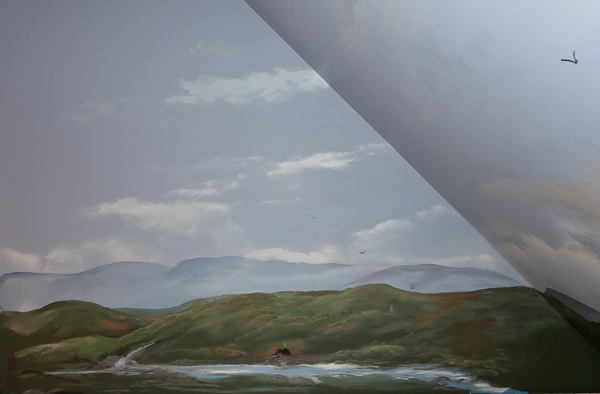
I hired a local mural artist, Gale Hinton, to work her magic. www.galehinton.com Above is just one view where she gave me rolling mountains, a waterfall, a cabin, birds, and even a still.

Here is an end view of the penisula showing the hinged, smoked acrylic fascia.

Here is a portion of the east side after the track for the industries has been laid and wired.

View of the cement and warehouses on the west side of the layout.

A bird's eye view of the turntable and yard as well as an overall view of the scenery completed on both sides. At the far end is a wye allowing point-to-point operations using two sides of the wye. There are actually two yard sections in this big yard. Each yard section will be used as the terminus of operating sessions. For open houses, the third leg of the wye is used to create a continuous running track - which takes about 11 minutes for a train to cover the entire mainline.
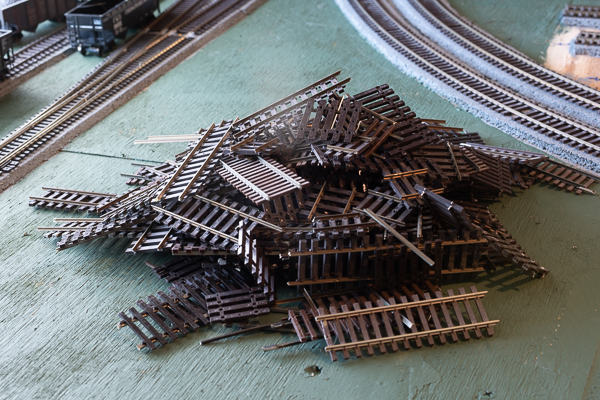
I collected all those short, unloved pieces of track just to see how many there would be. It turns out I have 124 pieces that were too long to toss, but too short to use. Some of them will be used in a rail salvage yard. The rest will be unceremoniously tossed.
I have added the ability to control my turntable with DCC and also automatically only power up the track the turntable is pointed to.
I have a large gorge in front of a window. In case I ever need to access the window, the gorge is removable. I'm using magnets to hold the gorge sides in place.
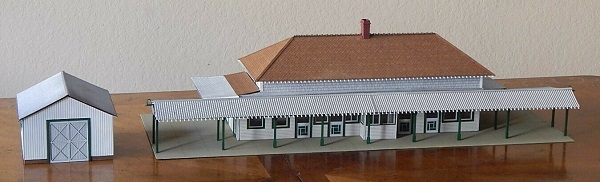
I bulit a kit of the station of my home town. How many people get to have the station of their home town on their layout?

Every great scene starts with a structure. The University of Tennessee sports teams are very popular in this area. So it was only fitting that I paint the support posts of my team track loading dock in team colors.
Trackwork
The track is code 83. Minimum radius is 31". Turnouts are #8 for the mainline passing. All industrial tracks use #6 turnouts. There are no industrial stubs off the mainline. The mainline does not pass through any diverging tracks (reverse) of turnouts. Yard tracks have a minimum spacing of 2.25" apart.

Scenes on the Kudzu & Tenn
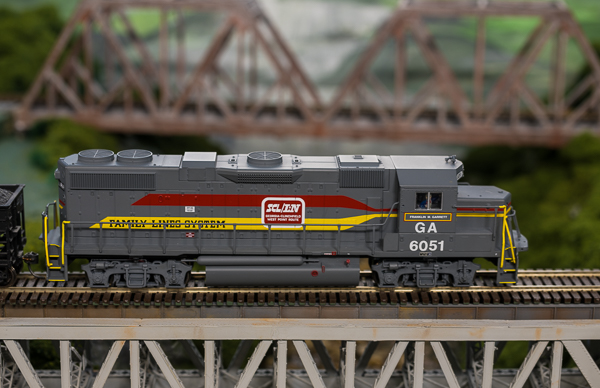
11/27/23: This photo features the Clinchfield's bridge at Pool Point in the foreground. In the background, is the model of the Clinchfield's unique bridge at Starnes. Both of these bridges were salvaged from my Texas layout.
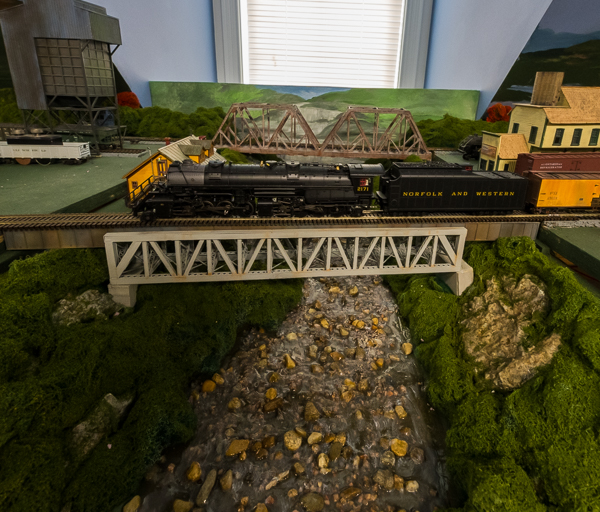
11/27/23: The bridges over Falling Water. The creek scenes are mostly done, but I still have the table tops to scenic.
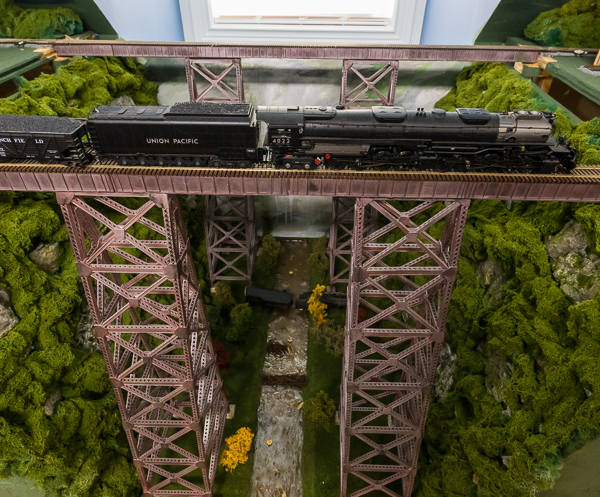
11/27/23: Both of these bridges over Frog Jump were salvaged from my Texas layout featuring the Clinchfield's Copper Creek Viaduct. It is about 167 feet to the bottom . Featured in this creek is a locomotive that fell over the side of the bridge, people tubing and a beaver dam and den.
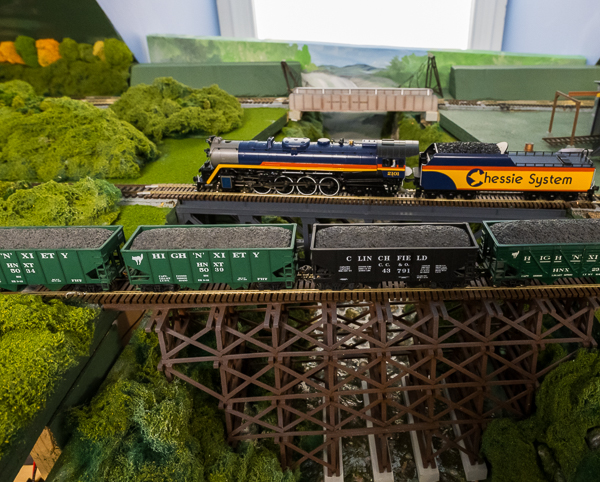
11/27/23: There are three bridges here over Suck Creek. The wooden trestle is the interchange track with Keith Elrod's Tellico Southern Railroad.
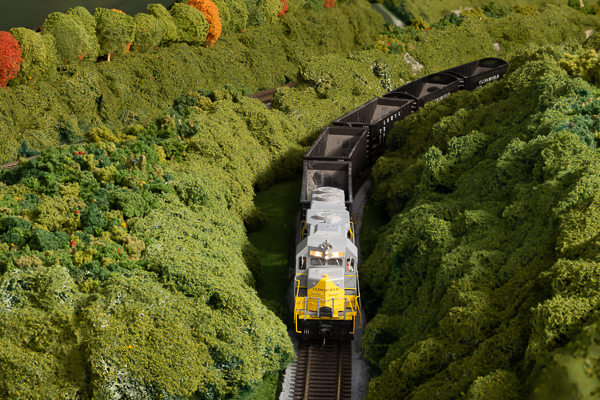
01/01/24: CRR 2006 exits the cut west of Big Boy Jct to return to the mine. The Kudzu and brushes in this scene were completed ahead of schedule. On to the rest of the layout!
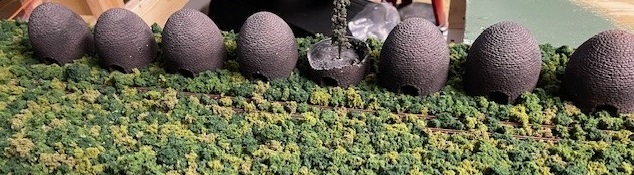
02/05/24: Abandoned beehive coke ovens. This type of coke oven went out of use about 1938; inappropriate for my 50's era layout. This makes good use of the area near the curved mainline that otherwise makes it difficult to place a working industry.
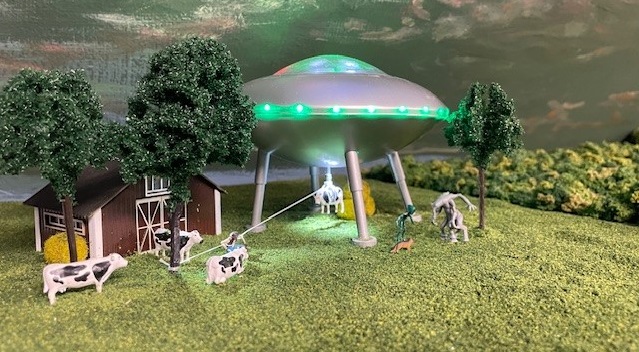
02/07/24: A UFO invades a farm on the Kudzu & Tennessee and attempts to beam up a cow. The farmer struggles to save his cow while the dog confronts two of the aliens.
Latest Pictures

06/23/25: Half of the coaling trestle. This was built from Clinchfield blue prints. The ramp to get the hopper cars up above the coaling bunkers was built leaving out every other bent. Still, the coaling trestle is the largest structure on my layout at 6 feet long.

03/31/25 One of the scenes along the west wall.

Here are the working crossing gates in the town of Moodyville. Yes, they go up and down, the lights alternately flash, and the bell sounds.(Note: The lights are both lit because of the long exposure used to take the picture.)

The coal mine tipple #1.

The coke works.

What is wrong with this picture?
a) Not enough locomotives.
b) Not enough storage tracks for more locomotives.
c) Too much isle space on the right, prohibiting the addition of more storage tracks, prohibiting the acquisition of more locomotives.
You're absolutely correct!
The "round house". Not actually having a round house solves two problems. The biggest problem is that engines are normally pulled straight into a round house and not all locos have a number on the back. It can be difficult to add a number to the back of a tender. So knowing the loco's DCC address can be a problem. Two, I could get more tracks in by not having a round house; so I can store more locos.

12/08/24 This is the first section after Moodyville had ground cover, roads, and ballast installed. This section is called Bucksnort (front) and Boom (back). As stated earlier, all town names are actual Tennesse town names. I selected Boom as the name for the back town because one of the businesses is a dynamite warehouse.
Each section on the east side is separated by a dormer window as seen on the left. In front of each window is a small river as shown above. The layout is a large dogbone and so the mainline passes through each scene twice. This doesn't bother me. I just don't plan to have operators working both towns at the sams time.
Earlier in the layout's construction, I painted the plywood in colors of about what I expected I was going to place in that spot; green for grass, black for spilled coal, etc. I had roughed out the towns then. Now that I am actually putting down the ground cover, I'm planning things in more detail; particularly where the roads and spilled coal and such go. I am finding that whatever I am putting down is completely covering up the paint; even if it is a different color. Lesson learned: there really is no need to prepaint the plywood other than to give it a somewhat finished look while waiting for you to put down ground cover.
Stay tuned!
As I do my scenery, I’ve come up with a new definition of “adhesive”: A substance that does not adhere to the surfaces listed on the can or bottle, but will instantly bond your fingers to whatever you are trying to glue down. By the time I am done gluing on the green polyfiber for the Kudzu, I end up looking like a green wookie.
Other cats on the Kudzu And Tennesse - 01/14/26
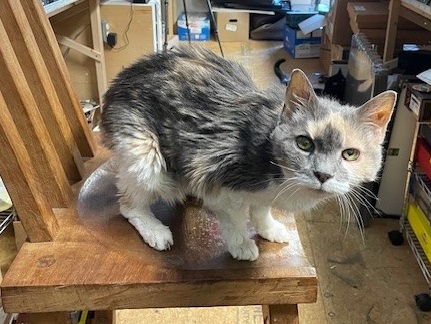 |
Bijou liked to visit while I was working on my trains and always announced herself when she walked into the room. She almost made it to be 22 years old. She passed away in January. |
 |
Oscar is our newest fury friend. Up until now, my cats have rarely knocked anything over. But today, Oscar jumped up on the layout just inches from my chiecken farm (foreground). I may have to rethink allowing cats into the train room. |
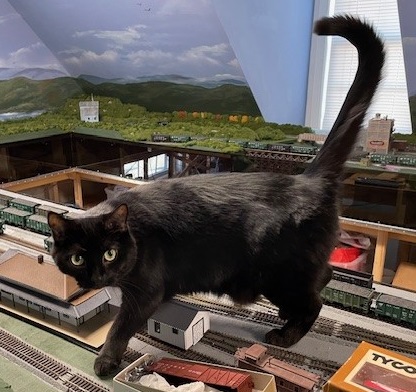 |
Jackson is Bijou's best friend forever. They spend a lot of time together. Here, Jackson is walking in the yard. |
 |
Stripey helps out in the office editing my website. |
 |
Beau is in management. He hardly ever shows up in the production area and as such, has no clue what is going on. But being a cat, he's curious; so it all works out. Today, he spent a lot of time on the railroad; probably trying to find somebody screwing up something so that he has an excuse to lay them off. |
"A little help from my friends."
Finally, I'd like to thank the following modelers who have helped build the Kudzu and Tennessee. Some times I just needed an extra hand. Other times, they were just better than I could have done, were much quicker than I am, or just simply helped out while I was focused on wiring.
Feroz Appaiwalla - scratchbuilding wooden structures
Jim Arrasate - model painting
Dick Brion - painting and weathering
Keith Elrod - billboard
Jim Grossen - terminal blocks and Arduino project
Don Clark - carpentry
Ken Klaviter - decoder installation and model fine tuning
Harley Nichols - scratchbuilding
Jan Shea - figure painting
Dennis Stoner - general layout work
Jim Vineyard - scratchbuilding wooden structures
Jack Wallschlaeger - craftsman kit construction and scratchbuilding
What is Kudzu?
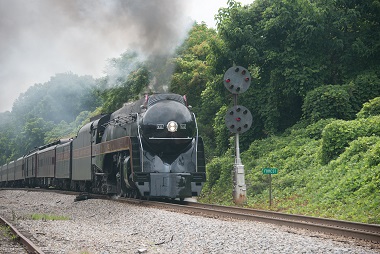 |
Kudzu is an invasive, fast growing vine brought to the southeastern United States to control hillside erosion. Unfortunately, its large leaves block the sunlight to the trees and other plants it covers killing them all. It is difficult to kill and it is said, "The only way to get rid of Kudzu is to move." So I have been careful to not buy a home that is anywhere close to Kudzu. Shown here is a hilside with Kudzu. When it goes dormant in the winter, it is a particularly ugly sight. |
Be sure to take this little picture
tour of Clinchfield
Country!
|
